
You drive hours to pick out a puppy. The breeder walks you right past the barn and into a spotless little room with a couch, a rug, and a baby gate. Someone carries in a puppy and drops it in your lap.
You ask to meet the mom. You ask to see where the dogs live.
“We don’t allow visitors back there. Biosecurity. We can’t risk bringing disease into the kennel.”
Don’t buy it. Not the line, and not the puppy.
We’ve heard this exact script during our own visits to commercial breeding facilities over and over but, once you understand how disease actually spreads, the excuse doesn’t just weaken. It collapses.
They Hand You the Puppy, Then Carry It Straight Back to Mom
Here’s what they’re counting on you not to notice. You’re “too dangerous” to stand near the mother dog. But you’re allowed to pick up her baby, cuddle it, kiss its head, and pass it around to your kids.
Then the breeder takes that same puppy out of the room and puts it right back with its littermates and its mother.
Think about that. If you were carrying a virus on your hands, your shirt, or your shoes, the breeder just hand-delivered it to every dog they claim to be protecting. The puppy is the bridge.
And parvo, the disease breeders love to name, spreads exactly this way. It travels on hands, clothing, shoes, bowls, and kennel surfaces. A young puppy who hasn’t finished its vaccines is the most vulnerable animal in the building, and that’s the one they put in a stranger’s arms.
If disease were truly the concern, the puppy room would be the most dangerous part of the visit. Instead, it’s the only part they let you see. That tells you everything.
Real Biosecurity Means Rules, Not Hiding
Biosecurity is real. Disease control matters. That’s exactly why this excuse is so insulting to anyone paying attention.
Real biosecurity looks like this: wash your hands, put on shoe covers. It does not look like “you can never see where the dogs live.”
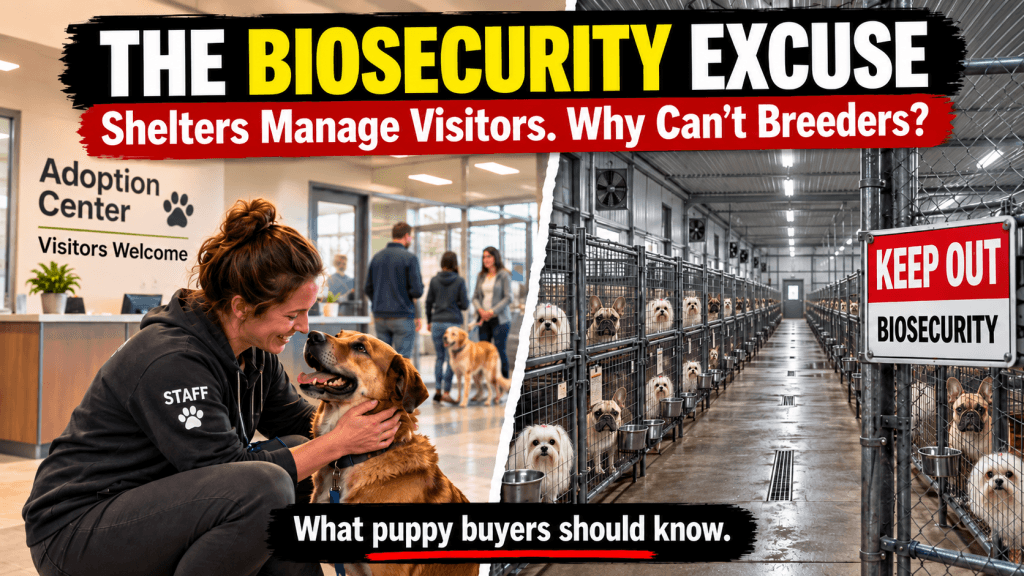
Shelters and veterinary clinics routinely use disease-control protocols while still allowing controlled public access. They don’t hide the animals.
Shelters and Veterinary Clinics Manage Disease Risk Without Hiding the Animals
Animal shelters and veterinary clinics deal with infectious disease every day, including parvovirus. Yet they do not solve that risk by permanently keeping the public from seeing the animals or the areas where animals are housed.
That is why puppy buyers should question a breeder who allows them to handle a young puppy but refuses any reasonable way to see the mother dog or the place where the dogs live.
Biosecurity should control how a visit happens — not be used to prevent a visit from happening at all.

What the Puppy Room Is Really Hiding
The mother dog is the evidence. Her body, her coat, her teeth, her nails, how she moves, whether she cowers when a person walks in. She shows you how this puppy started life and how she’s been living while she produced litter after litter.
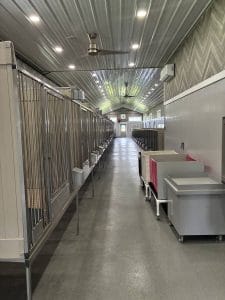
Where she lives is even more revealing. How many dogs are on the property? Are they stacked in wire-floored cages? Have they ever walked on grass? Do they look like pets, or like livestock?
Those are exactly the questions a separate puppy-meeting room may prevent buyers from answering.
Any breeder proud of how their dogs live would be dragging you out back to show you. When they won’t, that is a red flag.
Biosecurity Red Flags
The rules only stop you from seeing. You can hold the puppy but can’t see the mom. That is not enough information for a buyer to evaluate how the dogs actually live.
No protocol is offered. A breeder actually worried about disease would hand you shoe covers and point you to a sink. If the breeder offers no reasonable biosecurity procedure and simply refuses access, that is a red flag.
They offer a video call instead. A quick clip of a clean dog on a clean floor proves nothing. You don’t know if that dog is the mother, and you’ll never see where she spends the other 23 hours of the day.
The mom is “resting,” “out back,” or “not friendly.” New excuse, same result. You never see her.
Lots of breeds, lots of litters, all year long. Multiple breeds or designer mixes available year-round can be a sign of a high-volume operation.
Call the Bluff
Before you go, ask directly: “Will I be able to meet the mother dog and see where your dogs live?”
If they say biosecurity, call the bluff. Tell them you’ll wear shoe covers, wash up, and keep your hands off the adult dogs.
And if the answer is still no, walk away. Don’t buy that puppy to “save” it. Every dollar you hand over pays for the next litter and keeps that mother dog exactly where she is.
Can’t Meet the Mom? Don’t Buy the Puppy.
The puppy goes back to the kennel. You don’t. That one detail exposes the whole thing. This rule was never about protecting dogs. It’s about protecting the sale.
No mom, no sale.
Before buying, use our Dog Breeder License Lookup and learn more about buying a puppy online].