
I Spent Three Days With the Ridglan Beagles
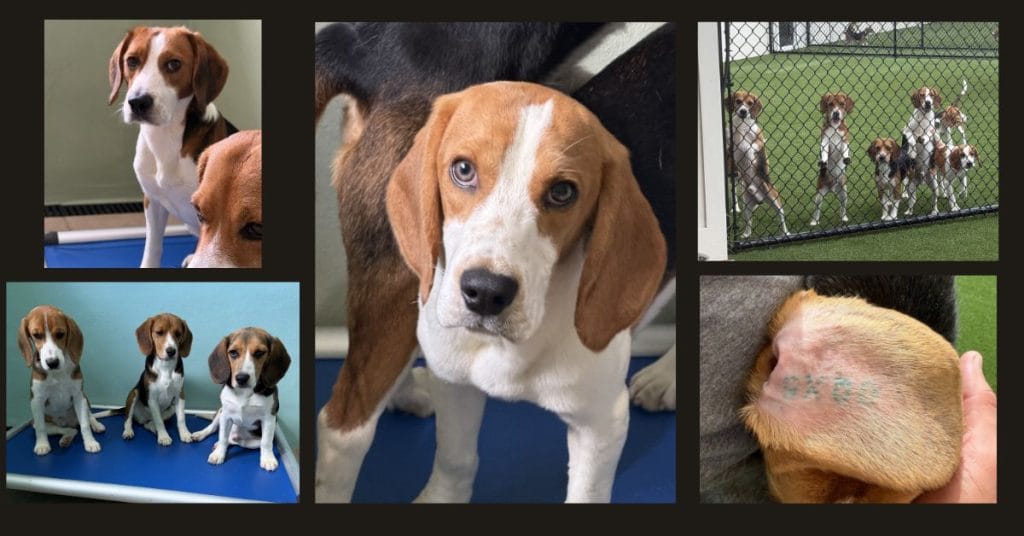
I’m Janie Jenkins, president of Stop Online Puppy Mills. I have personally met hundreds of dogs coming out of USDA-licensed commercial dog breeding facilities, and I know what many of them look like when they leave and what they may carry with them physically and emotionally. So when 1,500 beagles from Ridglan Farms in Blue Mounds, Wisconsin, arrived at Big Dog Ranch Rescue in Florida, I went. I spent three days with them. What I saw confirmed what I already knew from meeting hundreds of dogs from USDA-licensed commercial breeding facilities: a USDA license does not tell the public what life is actually like for the dogs behind the kennel doors.
What I saw broke my heart — but it did not surprise me. That is exactly the point.
The Ridglan Beagles were bred to be sold to research laboratories for testing. Puppies sold and shipped online are bred and marketed for families and living rooms. Those may sound like two different worlds, but they are not.
USDA licensed dog breeders can supply puppies to research, pet stores, puppy brokers, and online puppy-selling websites. They operate under the same USDA license and the same federal Animal Welfare Act standards but the businesses have different end users.
That is the connection consumers need to understand.
The same inspection standards that applied to Ridglan Farms also apply to USDA dog breeders producing puppies for the pet market.
What I Saw
The first thing I noticed was the eyes or more accurately, the absence of eye contact.
Dogs coming out of high-volume commercial kennel environments often learn to make themselves small. They avoid human eyes. They freeze. They move along walls. They hesitate before stepping toward kindness.
Some of the beagles desperately wanted human attention. They pressed their bodies toward me as if trying to make up for a lifetime of touch they never received.
Others were completely shut down.
Most were somewhere in the middle — cautious, conflicted, wanting to trust, but not knowing whether human hands were finally safe.
Then there were the physical signs.
I saw teeth covered in heavy plaque. Ears with painful hematomas. Ears that appeared to have been injured or torn that had healed poorly. Paws splayed from wire flooring. Older females whose bodies told the story of repeated breeding.
I was not surprised because I have seen these exact same physical and behavioral markers in dogs coming out of USDA-licensed commercial breeding facilities connected to online puppy sales and pet stores.
This is what people do not see when they look at a cute puppy photo online and why Stop Online Puppy Mills exists.
USDA Inspections Found No Violations — While State Records Told a Different Story
Ridglan Farms held a USDA Class A breeding license. As I said, this is the same federal license held by USDA commercial dog breeders who breed puppies for sale to the public, including breeders who sell through pet stores, brokers, or online puppy-selling platforms.
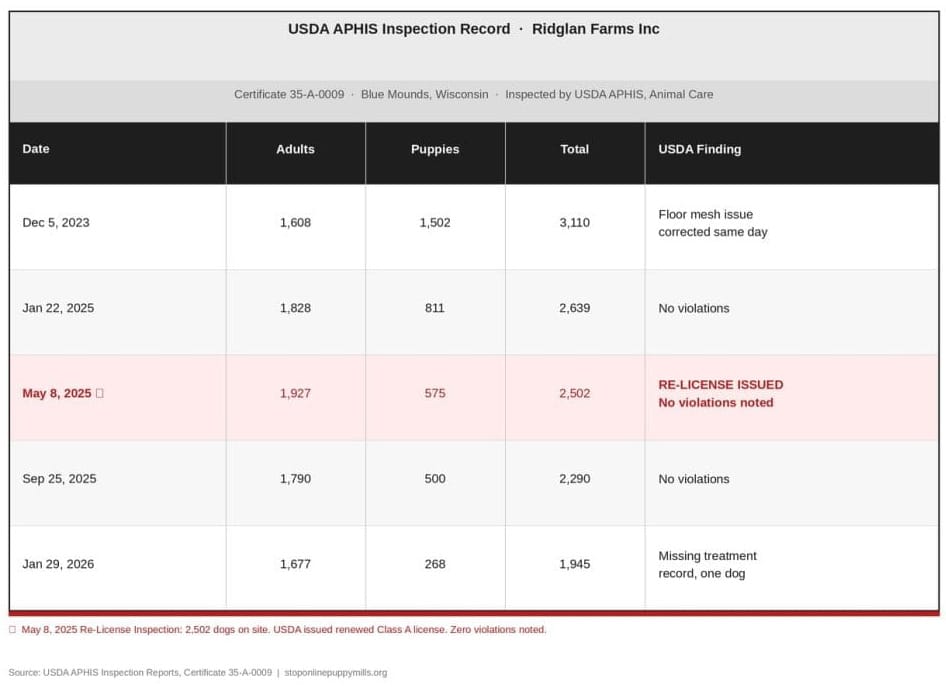
According to USDA inspection records, Ridglan Farms was inspected multiple times between 2023 and 2026 citing no violations. In May 2025, USDA records show a re-license inspection with 2,502 dogs on the premises — 1,927 adults and 575 puppies — where their Class A license was renewed.
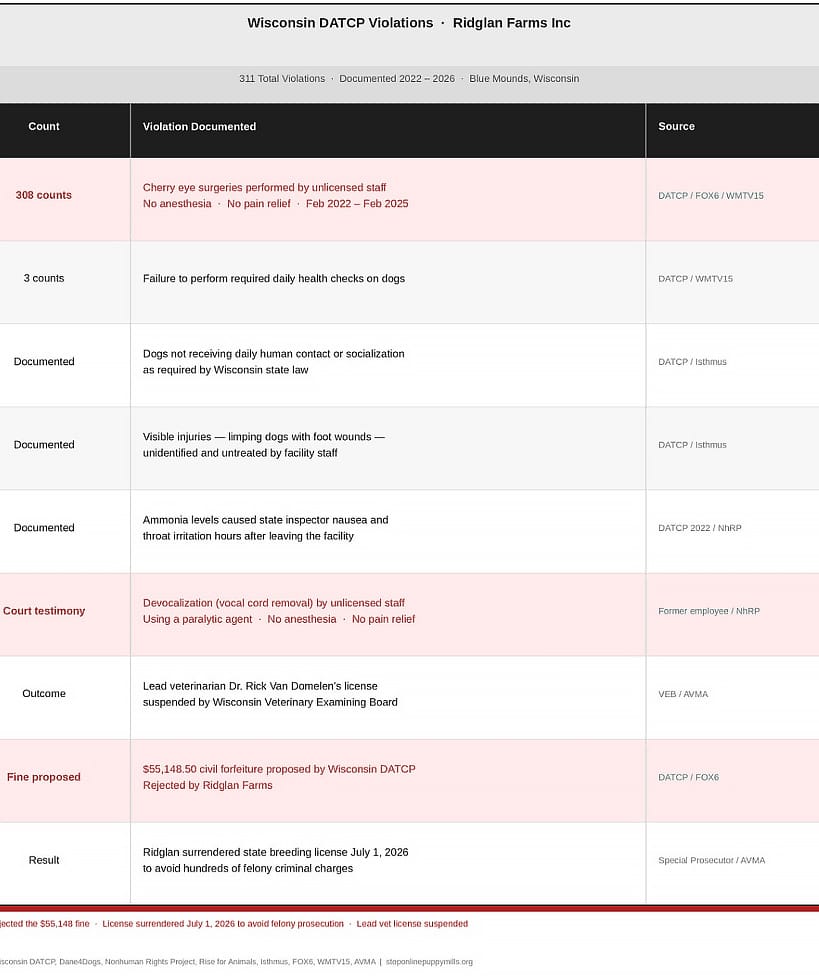
At the same time, Wisconsin state records documented hundreds of alleged or cited violations of state administrative rules, including serious concerns involving veterinary care, injuries, surgical procedures, and socialization.
The same facility. The same dogs. Two very different pictures depending on which records you read.
This is why consumers should never assume that “licensed” automatically means humane.
Inspection Records
The Animal Welfare Act Sets Minimum Standards — Not Humane Standards
The federal Animal Welfare Act passed in 1966 sets minimum care standards.
Minimum does not mean humane.
Federal standards allow dogs to be kept in enclosures only slightly larger than their bodies. They do not guarantee that a dog lives as a companion animal. They do not guarantee daily affection, meaningful enrichment, normal home life, or the chance to simply be a dog.
A facility can be licensed, inspected, and still raise serious concerns about whether dogs are receiving the quality of life the public imagines when they hear the word “regulated” or better yet, “licensed.”
Thank you to the Ridglan dogs for exposing this.
What Ridglan Farms Has to Do With Puppies Sold Online
When you see “USDA licensed breeder” on an online puppy listing, do not treat that phrase as a stamp of humane care.
Treat it as a reason to walk away.
- Who is the breeder?
- Where is the mother dog?
- Can you meet her?
- Can you see where she lives?
- How many adult breeding dogs are on the property?
- How many litters are produced each year?
- Does the seller use a broker, delivery service, or third-party website to keep buyers away from the kennel?
Many online puppy-selling websites and broker-style platforms — including sites such as Greenfield Puppies, Lancaster Puppies, PuppySpot, Pawrade, Crockett Doodles, and many others — present puppies through polished photos, names, descriptions, health promises, and easy reservation buttons.
If you cannot see the mother dog and the conditions she lives in, in person, you cannot truly know what system your money is supporting.
This is the connection Stop Online Puppy Mills wants every consumer to make: online puppy listings often show the puppy, but not the breeding system behind the puppy.